Short Barrel Rifles


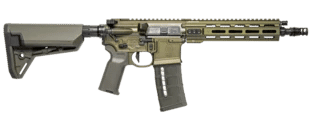

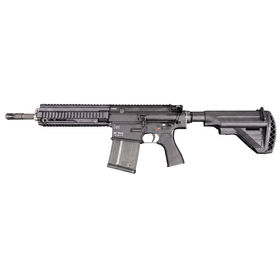

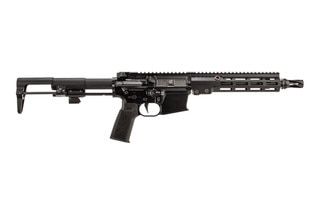


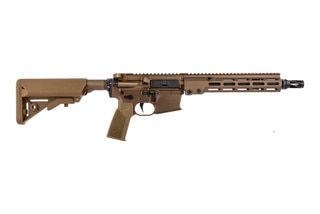


SBR Frequently Asked Questions
What is a short barrel rifle (SBR)?
A short barrel rifle, or SBR as its commonly abbreviated, is a rifle with a barrel length shorter than the federal minimum of 16 inches, or one that is shorter overall length than the federal limit of 26 inches. SBRs are regulated under the National Firearms Act (NFA), so purchasing one requires more paperwork than a standard rifle does. In addition to a standard FBI NICS (National Instant Criminal Background Check System) check, you’ll also need to go through an ATF background check, and submit both an ATF Form 4, and a set of your fingerprints—either physically on a set of FD-258 fingerprint ID cards, or digitally through a Kiosk. Most SBRs available in the Primary Arms catalog are built on the AR-15 platform, but there are a multitude of other platforms available in an SBR configuration too.
Are SBRs legal to own?
Yes, SBRs are legal to own in the United States, but it depends on the state you live in. At the Federal level, the ATF has made registration of NFA items, such as SBRs and Suppressors, voluntary as of October 9th, 2026. That said, state and local laws still vary, with some requiring you to register them with the ATF, while others have further restrictions or prohibit their ownership entirely. Your Federal Firearm License (FFL) dealer in your area can confirm whether you are able to take delivery, but since such laws and regulations change, always be sure to check the current federal, state, and local law before buying an SBR.
How do I buy an SBR from Primary Arms?
Buying an SBR looks different depending on the state you live in. If you live in a state that doesn’t require their registration, you can order them on Primaryarms.com, ship it to your local FFL Dealer, and complete a standard Form 4473 and NICS background check like you would with a standard 16-inch rifle.
If you live in a state that still requires SBRs to be registered with the ATF under the NFA, purchasing an SBR is a multi-step process. First, place your order with Primary Arms, and ship it to your FFL Dealer of your choice that accepts and transfers NFA items. Once it arrives, you’ll fill out and file an ATF Form 4 with that dealer and submit a set of your fingerprints along with it. This can be done with physical paperwork and a set of FD-28 Fingerprint ID cards, or it can be done digitally so long as your FFL of choice has a Silencer Shop Kiosk setup. Either way, once your forms and fingerprints are sent off, you’ll wait until the ATF approves them, at which, you’ll return to your FFL, finish the transfer, and take the rifle home.
Approval times vary. If you can file digitally, we recommend doing so, as it speeds up the process tremendously. Filing your paperwork physically isn’t a bad option, but it can take a lot longer.
What does an SBR cost overall?
Since the price of the Tax Stamp has been reduced to $0 as January 1st, 2026, the only added cost you’ll need to pay on top of the base price of the rifle is the shipping fee and your FFL’s transfer fee. Dealers set their own transfer fees, so be sure to ask your FFL of choice before you order.
What's the difference between an SBR and an AR pistol?
The main difference is how the firearm is built and how federal law classifies it. An SBR is built like a rifle, regardless of its barrel length. It has a stock and barrel shorter than the federal rifle at least 16 inches. As such, it falls under NFA restrictions so long as your state still requires their registration. An AR pistol has no stock, and they’re treated like standard handguns. AR pistols, depending on the state, can have arm braces instead of stocks, and while they don’t require ATF registration and approval, you can’t treat them like a rifle. For instance, they can’t have a vertical foregrip, and you can’t swap the brace for a stock without registration.
ATF rules and regulations often change over time, so we recommend reading our guide to ATF rule changes for SBRs and suppressors for background, and check current ATF guidance and your state law before you buy.
What barrel length should I choose for an SBR?
Choosing the right barrel length depends on what caliber it’s chambered in, as well as how you plan to use the rifle. Most AR-15 SBR buyers often choose a rifle with a barrel length that’s between 7 and 14.5 inches, with 10.3-, 10.5-, 11.5-, and 12.5-inch options being the most common. Shorter barrels are easier to handle in tight spaces but give up some velocity and range. Longer barrels add velocity and range but are less compact.
If you’re shopping for a 5.56 NATO SBR, the 11.5-inch SBR is one of the most popular options, as it’s a solid middle ground for 5.56 NATO, offering maneuverability in close quarters, while still having the capability to reach out to 350 yards or farther. Lower pressure cartridges, like .300 Blackout, are designed to perform better out of shorter barrels. So, such rifles often come equipped with shorter 8-, 7.5-, and 5.5-inch barrels. We recommend checking out our guide on SBR Barrel Lengths for some further insight into what option might work better for you.
Can I put a suppressor on an SBR?
Absolutely. Suppressors and SBRs are an excellent pairing, with the shorter barrel helping to offset the length and weight that a suppressor adds. Each one is a separate NFA item, though. So, if you live in a state that requires their registration, keep in mind that they’ll each require a separate Form 4, fingerprint submission, and a separate transfer.
Before purchasing a suppressor for your SBR, be sure to check the rifle's thread pitch or QD muzzle device to make sure it matches the suppressor's mount. Read our guide to SBR performance with suppressors for the tradeoffs, then browse suppressors to find one that fits your caliber.
What should I look for in the best SBR?
The best SBR is the one that’s built for how you plan to use it. Start with the caliber, then match the barrel length to your caliber’s ballistics and the rifle’s intended purpose. Once you’ve narrowed in on some options, look at each rifle’s barrel quality, taking note of the steel it uses, whether it has chrome lining, and its twist rate. Next, check the gas length to make sure it’s optimal for the barrel, as rifles with shorter barrels often run into reliability issues when improperly gassed. Look at the handguard, trigger, and overall build quality from the maker.
There are several great options to choose from, but it’s important to note that not every rifle is created equally. What may work for one person might not be ideal for another. As such, it’s important to take ample time when selecting an SBR, as the purchase process can be far more involved than it is with a standard rifle.
Can I travel across state lines with an SBR?
Interstate travel with an SBR has federal requirements that a standard rifle does not. With the new change that has made registration voluntary, you can travel from state to state with an SBR obtained through a standard 4473, so long as the state you travel to does not require NFA item registration. If you’re travelling to another state that requires registration, you cannot legally transport an SBR that isn’t federally registered with the ATF under NFA law. In addition to this, NFA item owners generally must get ATF approval before moving an SBR across state lines, even for a short trip. The destination state must also allow SBR ownership. Rules and forms can change, so check current ATF guidance and the laws of every state you will pass through before you travel.