Primary Arms Rifle Scopes





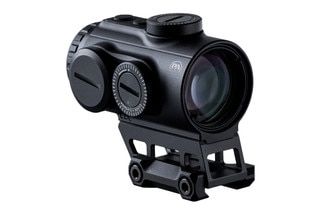
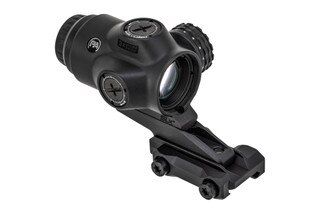
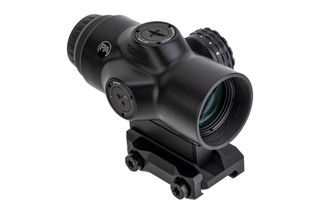
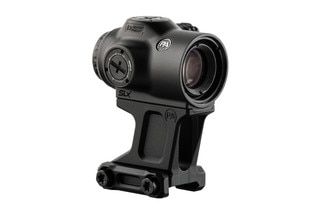


Prism Scope Frequently Asked Questions
What is a Prism Scope?
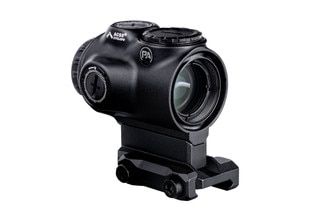
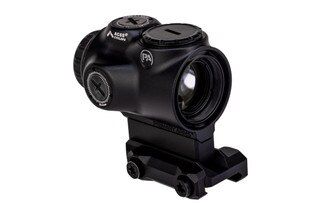
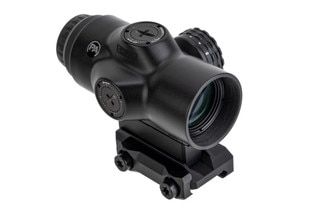
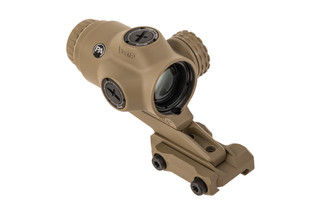
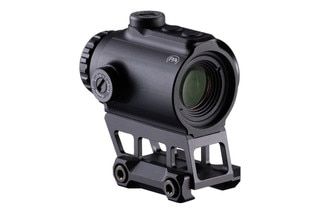
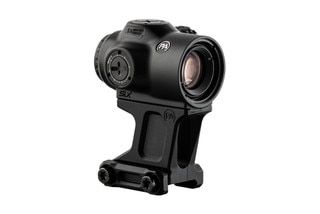
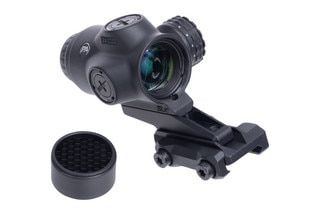
Prism Scopes offer a fixed magnification in a relatively small package by redirecting light through an internal glass prism. You may read terms like Pechan prism, Porro prism or Roof prism when researching these scopes, but the bottom line is that this technology is highly durable and extremely well proven.
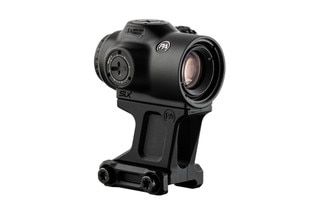
Prism scopes, like the Primary Arms MicroPrism™ are a superb choice for a basic and super tough do everything scope. Simple to install and operate, prism scopes are lighter than conventional rifle scopes with similar magnification levels and features. Despite their compact form-factor, prism scopes are exceedingly rugged.
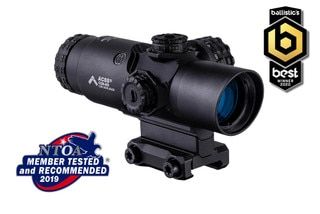
With decades of battlefield exposure, prism optics like the Trijicon ACOG series have proven their reliability in the most hazardous conditions on earth. No optic is without compromise. Prism scopes are only a fixed magnification, so they lack the versatility of variable zoom optics.
Check out our Guide to Prism Scopes to learn more about these optics and to find out if a prism scope is a good choice for you.
What are Prism Scopes, and how are they different from Traditional Rifle Scopes?
The primary difference between prism scopes and traditional rifle scopes goes beyond their respective sizes.
Prism scopes use internal glass prisms to pick up and fold light within the optic, shortening the optical path, and providing a clear and magnified picture of sight picture. Traditional rifle scopes, or variable power rifle scopes, make use of a set of lenses within a larger, tubular optic body to magnify a sight picture.
Additionally, prism scopes have a fixed magnification level instead of variable power, with them most often ranging in power from 1x to 6x magnification. Even though they have less power, their use of a single prism allows them to be much more compact than variable power optics.
Can you use a Red Dot Magnifier with a Prism Scope?
Yes, but only with select, 1x Prism Scopes. Optics like the CLx 1x, SLx 1x, and GLx 1x MicroPrism Scopes are compatible with red dot magnifiers, allowing you to extend the usable distance of your optic. This is largely due to the adjustable diopter ring they house. With it, you can easily dial in the focus of your optic so that it aligns well with your magnifier of choice.
Not all 1x prism scopes are designed to be used with magnifiers. It’s best to check the manufacturer’s website and optic manuals to make sure they are before buying. Additionally, you can’t use a magnifier with any prism scope that has a magnification level above 1x. Combining the two magnifications creates a distorted sight picture, scope shadowing, and a borderline unusable eye-relief. So, if you’re planning to use a magnifier with your optic, be sure to opt for a 1x prism scope that’s compatible with them.
What are the benefits of using etched reticles?
Etched reticles have a lot of advantages. For starters, since the reticle is physically etched into the lens of the prism scope, it’s always visible, regardless of illumination. Modern prism scopes can house exceptionally bright reticles too—models like the SLx 1x MicroPrismT with the T-Dot Reticle use PAO’s Red Dot Bright® design, which places a micro-etched reflective grating on the reticle. As such, when illuminated, their brightness is on par with many reflex sights.
One other advantage etched reticles offer is their clarity, specifically regarding astigmatism. Etched reticles are far less prone to astigmatic distortion compared to projected reticles. So, if you have astigmatism, you’ll likely find prism scopes easier to use.
What Magnification levels are Primary Arms Optics Prism Scopes Available in?
Primary Arms offers a multitude of Primary Arms Optics Prism Scopes in their CLx, SLx, and GLx Optic Tiers, and they’re available at multiple magnification levels.
The CLx 1x and CLx 3x Prism Scopes have a 1x and 3x magnification level, respectively. They’re also among the most affordable prism scope models offered by Primary Arms.
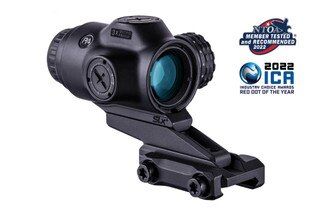
The SLx MicroPrism line is the most popular in their lineup, with them being available in either a 1x, 3x, or 5x configuration. The newer SLx 1x MicroPrismT is only available in a 1x configuration, and both the SLx 3x32 and SLx 5x36 Gen III Prism Scopes have a 3x and 5x magnification level, respectively.
Finally, the GLx line consists of the GLx 1x MicroPrism and GLx 2x Prism Scope. The GLx 1x MicroPrism scope is essentially an upgraded version of the SLx 1x MicroPrism with enhanced glass, push button controls, and a larger diameter objective lens—it retains the 1x magnification level. The GLx 2x Prism scope is one of the more unique models they offer, coming with a 2x magnification level.
What is the difference between the SLx and GLx prism scope lines?
The SLx optic tier is Primary Arms Optics’ entry level tier, blending quality and affordability. The GLx tier is a step above the SLx tier, offering a number of enhancements at a slightly higher cost, while still remaining relatively affordable.
What does “MicroPrism” mean, and how does it differ from the standard Gen III prism scopes?
‘MicroPrism’ is the model name for Primary Arms Optics’ compact prism scopes. Compared to the Gen III Prism Scopes, they have a much smaller footprint that’s comparable to many red dot sights. The SLx Gen III Prism Scope models (3x32mm, 5x36mm) are comparatively bigger, with them having larger optic bodies and objective lens diameters.
What is an ACSS® reticle, and why does it matter for a prism scope?
The Advanced Combined Sighting System®, or ACSS, family of reticles consist of Primary Arms Optics’ proprietary reticle designs. The ACSS reticle family distills the complex mathematics needed for precision into intuitive reticle designs. They can include multiple elements ranging from ballistic drop compensation (BDC) holds and auto-ranging stadia to windage/moving target holds to infinitely precise center chevron aiming points.
The SLx 1x and GLx 1x MicroPrism scopes can come equipped with the ACSS Cyclops® Reticle, an agile design that works great in fast-paced applications, and it offers some ranged capabilities when paired with a magnifier. In addition to this, they can also house the ACSS Gemini® Reticle, a BDC-based reticle that’s calibrated specifically for 9mm, making it a great option for pistol caliber carbines (PCCs).
Prism scopes with magnification above 1x, like the SLx 3x MicroPrism, can come with more specialized reticles like the ACSS Raptor® 5.56/.308 Meter Reticle, which has multiple BDC holds that are calibrated for both 5.56 NATO and .308 Winchester.
There are several reticles in the ACSS family of reticles that are used on Primary Arms Optics’ prism scopes. This reticle overview goes over each one.
Can a Prism Scope be used with Night Vision?
Yes, but not always. Certain prism scope models come with night vision compatible brightness settings, while others don’t. We recommend shopping with the “Night Vision Compatible” filter on if you’re planning to use your optic in conjunction with night vision devices like NODs (Night Optical Devices).
Are Prism Scopes Better than Red Dots or Low-Power Variable Optics (LPVOs)?
It depends on how you plan to use your rifle.
Compared to red dot sights, prism scopes offer more detailed reticle designs that are easier to see if you have astigmatism and can also be used when not illuminated. Depending on the model prism scope you choose, they can be as compact as some red dot sights, but keep in mind that models with higher magnification can weigh several ounces more than red dots at times. However, this doesn’t make prism scopes better than red dots by default. Red dots tend to offer more dedicated night-vision settings than prism scopes, and they’re often more affordable at times, although this isn’t always the case.
Compared to LPVOs, magnified prism scopes can be a great alternative for those wanting a lighter optic for medium- to long-distance use, but it’s critical to note that they lack the on-the-fly adaptability that LPVOs provide. Prism scopes essentially lock you into one specific magnification setting, while LPVOs have variable power that can adjust anywhere from 1x magnification to 4x, 6x, 8x, and even 10x magnification, depending on the model.
Ultimately, neither prism scopes, red dot sights, or LPVOs are inherently better than the other. They each offer unique features that make them better for different use cases.
Do Primary Arms prism scopes require a specific mount, or do they come with one included?
The mounting compatibility of Primary Arms Optics’ prism scopes varies. The SLx/GLx MicroPrism Scopes and the GLx Prism Scopes use the Primary Arms MicroPrism/Trijicon Mini-ACOG mounting footprint. The larger SLx Gen III Prism Scopes use a standard Trijicon ACOG mounting footprint. Regardless of which model you look at, they all come with standard with an optic mount. Primary Arms also offers other mounts that are compatible with these optics as well.
Newer prism scopes like the SLx 1x MicroPrismT and the CLx 1x and 3x Prism Scopes use an H1/T1, or Aimpoint Micro, mounting footprint. This is arguably the most popular mounting footprint used on compact red dot sights, making them compatible with several of the industry’s most popular aftermarket mounts.
If you’re looking for a specific mounting compatibility, we recommend checking the “Mount Compatibility” spec on each product page to confirm it uses the mounting footprint you prefer before buying.